


Puglia, The Slow Way: Where to Stay, What to See & How to Experience Salento

Puglia is not a destination I would recommend rushing through. The region rewards a slower approach, where a morning drive through olive groves can be as enjoyable as arriving at a famous town, and a long lunch can easily become the centerpiece of the day.
What I like most about Puglia is the contrast. There are elegant Baroque cities, tiny villages, historic palazzi, ancient masserie and beautiful coastline, but there is also a simplicity to everyday life here. Olive oil, fresh seafood, handmade pasta, local wines and long meals remain an important part of the experience.

Photo/Massimo Virgilio
For this trip, I would concentrate on Salento, the southern part of Puglia. This is where the landscape becomes particularly distinctive, with the Adriatic on one side, the Ionian Sea on the other and small towns scattered across a countryside defined by olive trees and dry-stone walls.
The key is not trying to see everything. Instead, choose a beautiful hotel, rent a car and allow yourself enough time to explore without turning every day into a checklist.
Getting to Puglia
For Miami travelers, one of the easiest ways to reach Puglia is to fly nonstop from Miami International Airport (MIA) to Rome Fiumicino Airport (FCO). ITA Airways and American Airlines currently offer nonstop service, with ITA listing the flight at approximately 10 hours and 10 minutes. Schedules vary by date, so I would compare both airlines when booking.
Rome makes a convenient connection point because you can continue directly to either Brindisi Airport (BDS) or Bari Airport (BRI). If you prefer to visit Rome before heading to Puglia, read our Rome travel guide.
For a trip focused on Salento, the southern part of Puglia, I would choose Brindisi. The nonstop flight from Rome Fiumicino takes approximately 1 hour and 10 to 15 minutes, with ITA Airways and Ryanair currently operating the route..

Photo/Giordano Rossoni
Bari is farther north and makes more sense if you are combining Salento with destinations such as Alberobello, Ostuni and the Valle d'Itria. Direct flights from Rome Fiumicino to Bari take approximately 1 hour and 5 to 10 minutes, with ITA Airways, Ryanair and Neos currently offering nonstop service.
Once you arrive, rent a car. While you can reach some of the major towns by train, having your own vehicle makes a significant difference in Puglia. It allows you to stop at a small village, pull over for a coastal view, visit a masseria or change your plans completely when you discover somewhere that looks interesting. Note: Be sure to book your car in advance, specially during high-season.
When to Go
I prefer late spring and early fall, particularly May, June, September and early October. The weather is generally well suited to sightseeing, outdoor dining and spending time along the coast, without the intensity of the peak summer season.

Photo/Vincenzo De Simone
July and August are the busiest months and can be very hot. If you are planning long days at the beach, summer obviously has its advantages, but if you want to explore Lecce, Otranto and the smaller towns comfortably, I would choose the shoulder seasons.
September is particularly appealing. The sea remains warm, restaurants and hotels are still operating at full pace and the atmosphere is noticeably more relaxed.

Photo/Robert Bye
What to Avoid
The biggest mistake in Puglia is trying to cover too much territory.
It is tempting to create an itinerary that includes Bari, Alberobello, Ostuni, Lecce, Otranto, Gallipoli and Santa Maria di Leuca in just a few days. You can do it, but you will spend much of the trip in a car.
Instead, I would divide the region into sections and give each area enough time.
Also, avoid treating the historic towns as quick photo stops. Lecce, for example, deserves several hours of simply walking, stopping for coffee and looking at the architecture. The same applies to Otranto and the smaller villages.
And don't underestimate the importance of lunch. Puglia is a place where a meal can easily take longer than you planned.


Photo/Luca/Unsplash
Where to Stay
For me, the right Puglia hotel is part of the destination. Rather than choosing a property simply because it is convenient, look for one that gives you a sense of where you are.
For this trip, three hotels offer three very different versions of Salento:
Baglioni Masseria Muzza Resort & Spa
A tranquil, restored 17th-century limestone whitewashed farmhouse that pairs traditional Puglian architecture with minimalist modern luxury. Read the full review of Baglioni Masseria Muzza Resort & Spa here.

Baglioni Masseria Muzza Resort & Spa
Palazzo Daniele
A 150-year-old aristocratic residence in Gagliano del Capo transformed into an avant-garde boutique stay showcasing restored 19th-century frescoes alongside contemporary art installations. Read the full review of Palazzo Daniele here.

Palazzo Daniele
Palazzo Ducale Venturi
A meticulously restored 16th-century ducal palace featuring vaulted ceilings, lush secret gardens, and a subterranean wellness spa. Read the full review of Palazzo Ducale Venturi here.
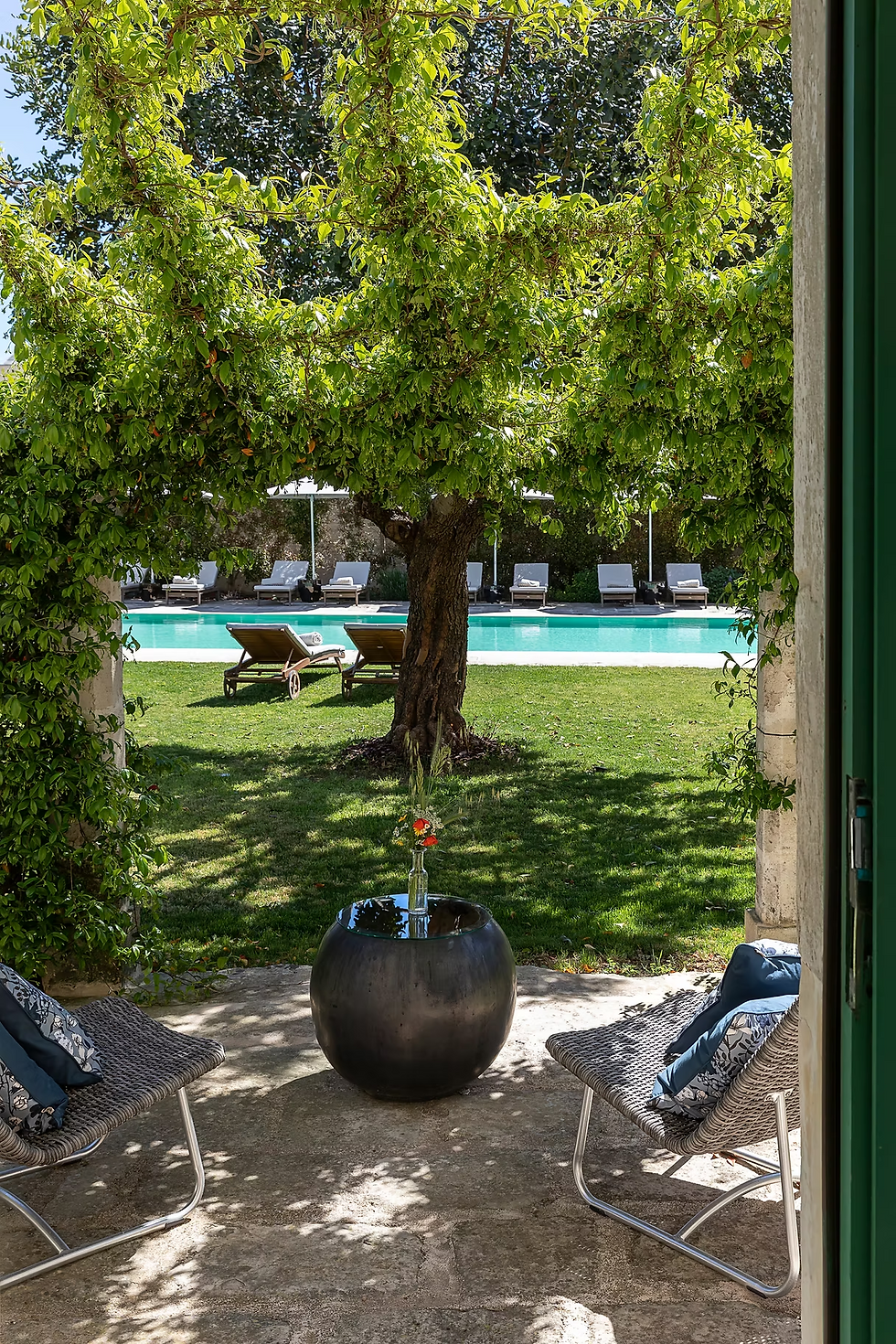
Palazzo Ducale Venturi
12 Places Worth the Drive
1. Lecce
Start here for the architecture. Lecce's elaborate Baroque buildings, churches and palazzi make it one of the most distinctive cities in southern Italy. Give yourself time to walk rather than simply moving between monuments. The city is particularly known for its use of local Lecce stone and its concentration of Baroque architecture.
2. Otranto
Otranto combines a beautiful historic center with an Adriatic setting. The cathedral, with its extraordinary medieval mosaic floor, and the Aragonese Castle are two essential stops. The coastline around Otranto also includes several beaches and coves.
At the southern tip of Salento, Santa Maria di Leuca is where the Adriatic and Ionian seas meet. The waterfront, villas, lighthouse and surrounding coastline make this one of the most memorable drives in the region.
4. Alberobello
The famous trulli are worth seeing, particularly if it is your first visit to Puglia. Go early and allow yourself time to walk beyond the busiest streets.
5. Ostuni
The whitewashed hilltop town remains one of Puglia's most recognizable destinations. Wander through the old center, stop for lunch and take in the views across the surrounding countryside.
6. Gallipoli
The old city sits on an island connected to the mainland by a bridge. Its waterfront location gives it a different personality from the inland towns, particularly in the evening. Gallipoli is also known for its beaches, Baroque churches and lively summer atmosphere.
7. Castro
This small Adriatic town is known for its dramatic coastline and marina. A boat trip is one of the best ways to appreciate the caves and cliffs along this section of coast.
Known for its thermal tradition and distinctive villas, Santa Cesarea Terme is a worthwhile stop when driving the Adriatic coast. It is also a good place to slow down and enjoy the views rather than treating it as another quick sightseeing stop.
If you want a beach day, Torre dell'Orso is one of the better-known stretches of coastline in Salento, with clear water and a long sandy beach. The area is particularly popular during summer.
10. Baia dei Turchi
Near Otranto, this protected coastal area combines Mediterranean vegetation, rocky sections and clear water. The bay is part of the protected Alimini Lakes area and is reached by a path through the pine forest.
11. Tricase
Tricase gives you a good combination of historic architecture and access to the Adriatic coast. It is also a useful stop when exploring the southern part of Salento, particularly if you want to see a town that feels less dominated by tourism.
12. Porto Cesareo
On the Ionian side, Porto Cesareo has a different coastal character, with long sandy beaches, dunes and shallow, clear water. It is a good choice for a relaxed beach day.
The Smaller Side of Salento
Some of my favorite moments in Puglia are not necessarily attached to a major attraction. You can get additional info here.
Gagliano del Capo
This small town near the southern tip of Salento is a good place to slow down and experience a more local side of the region. Its location also makes it convenient for exploring Santa Maria di Leuca and the surrounding coastline. It is also home to Palazzo Daniele.
Minervino di Lecce
Minervino is quieter than the better-known towns and offers a chance to see another side of Salento. It is exactly the kind of place where I would spend an afternoon without a strict itinerary. It is also home to Palazzo Ducale Venturi.
Specchia
Spend some time walking through the historic center, looking at the stone architecture and small courtyards. It is a good example of why I recommend leaving room for smaller towns.
Presicce-Acquarica
Presicce offers a glimpse into the agricultural history of southern Puglia, including traditional buildings and underground spaces connected to olive-oil production.
The Salento Countryside
Don't underestimate the pleasure of driving through the countryside with nowhere particular to be.
The olive groves, dry-stone walls, old farmhouses and masserie are part of the landscape that makes Puglia feel different from other parts of Italy. Sometimes the best stop is simply the one you did not plan.
Before You Go
Rent a car: Especially important if you are staying in southern Salento.
Don't over-schedule: Build in time for long lunches, beaches and spontaneous stops.
Start early: Historic towns and popular beaches are much easier to enjoy before the midday crowds.
Stay longer: Three or four nights in one area is more enjoyable than changing hotels every night.
Book restaurants: Particularly during July and August.
Bring comfortable shoes: Historic centers have uneven stone streets.
Eat locally: Try orecchiette, friselle, fresh seafood, local cheeses, olive oil and pasticciotto.
Try the wine: Salento is home to distinctive wines including Primitivo, Negroamaro and Salice Salentino.
Explore both coasts: The Adriatic and Ionian sides offer noticeably different landscapes.
Leave time for the hotel: In Puglia, a beautiful masseria, palazzo or historic residence is not simply where you sleep. It is part of the reason to go.