


REEFLINE Expands Miami Beach Underwater Corridor with Petroc Sesti’s Heart of Okeanos
Off the coast of South Beach, REEFLINE is set to expand its public underwater sculpture park during Miami Art Week 2026 with the deployment of its second permanent installation, Heart of Okeanos. Conceived by British artist Petroc Sesti, the 26.1-ton sculpture functions as a hybrid reef engineered to foster marine biodiversity while establishing an accessible diving and snorkeling site. Weather permitting, Kearns Construction will deploy the artwork in December 2026, placing it 20 feet beneath the surface off 5th Street, just west of the project's inaugural installation.
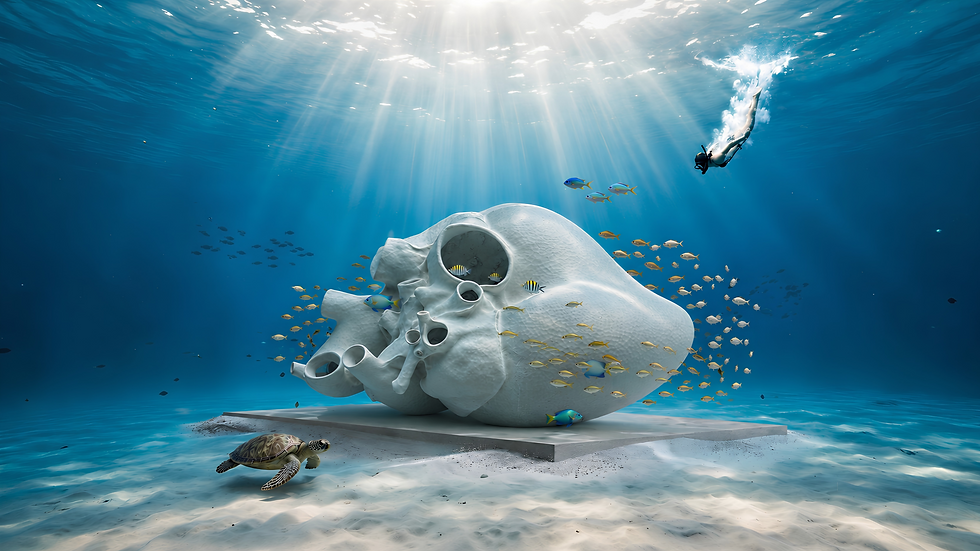
Heart of Okeanos by Petroc Sesti. Artist concept rendering. Photo/Courtesy of Platform Earth and Mateo Rembe
The sculpture draws its form from the anatomy of a blue whale's heart. Sesti began developing this series after an adult blue whale washed ashore in Rocky Harbour, Newfoundland, in 2014. A research team from the Royal Ontario Museum, led by former Senior Curator of Mammals Mark Engstrom and mammalogy technician Jacqueline Miller, spent three years preserving the 400-pound organ. Sesti studied the preserved specimen to create an ocean-bound habitat that translates mammalian cardiovascular architecture into a functional haven for Atlantic sea life.
Engineering a Living Marine Habitat
Translating the vascular system of the planet's largest mammal into a marine-grade reef required balancing aesthetic precision with coastal engineering. New York firm Scott System fabricated the molds, while South Florida company Alcrete cast the piece using a pH-neutral, mineral-rich concrete compound designed to facilitate larval settlement and coral attachment.

Deployment Render of Heart of Okeanos by Petroc Sesti. Photo/Courtesy of REEFLINE
The structure measures 17 feet in length, 7.6 feet in height, and 9.5 feet in width. Its hollow chambers, ledges, and flow channels are tailored to replicate natural reef topographies, offering shelter, feeding surfaces, and breeding grounds for resident fish and invertebrates.
“I hope Heart of Okeanos can become a small beacon for ocean conservation, a work to be found, explored and discovered beneath the surface by swimmers and divers, and in time, a home to an entire marine ecosystem,” Sesti said. “On a seabed of shifting sand, where marine organisms struggle to establish themselves, the sculpture will provide a permanent substrate upon which life can flourish. As the ocean gradually colonises its surface, the heart will evolve beyond my own sculptural intentions, becoming a living creation shaped by the marine life it supports. Through the extraordinary collaboration of marine biologists, oceanographers, curators and the City of Miami Beach, I hope Heart of Okeanos can demonstrate how contemporary art can deepen our understanding of the ocean, bringing scientific knowledge into the realm of human experience, curiosity and imagination.”
The deployment marks the completion of REEFLINE's second development phase. The initial installation, Concrete Coral by Argentine artist Leandro Erlich, was placed on the seabed in October 2025. Monitoring data compiled by the Lirman Lab at the University of Miami Rosenstiel School documented a 379 percent increase in total fish abundance across the site between November 2025 and July 2026, recording 35 distinct fish species inhabiting the artificial reef structure.

Petroc Sesti Portrait. Photo/Courtesy of Matt Porteous
Alongside Heart of Okeanos, the team will deploy the first underwater mile-marker module designed by the architecture firm OMA. Taking formal cues from natural coral colonies, these markers provide supplementary microhabitats while displaying navigational and interpretive details for visiting divers.
Dedication to Dr. Sylvia Earle
To mark the conclusion of the second phase, REEFLINE will formally dedicate the marine zone containing both Concrete Coral and Heart of Okeanos as the Dr. Sylvia A. Earle Reef. The designation recognizes the oceanographer, author, and Mission Blue founder, who advised the initiative during its conceptual stages and assisted in outplanting its first corals.
“When Petroc first showed me his vision for Heart of Okeanos, I felt it captured the spirit of REEFLINE,” said Ximena Caminos, CEO and founder of REEFLINE. “Whales have always filled me with wonder, and Petroc translates that wonder into art. Bringing this extraordinary heart to life has pushed the boundaries of our technical capabilities in fabrication, casting, and deployment. It is one of our most ambitious undertakings, and one of the most meaningful. It brings together so much of my life’s purpose: honoring the whale, the ocean, and the artist’s vision while creating a home for marine life. The future of the ocean depends on where we choose to put our hearts.”

Petroc Sesti and Ximena Caminos
Founded by Caminos and masterplanned with Shohei Shigematsu of OMA, REEFLINE operates as a 501(c)(3) nonprofit public-private collaboration supported in part by a $5 million City of Miami Beach general obligation bond approved by voters. The initiative involves coordination with Miami-Dade County, the Florida Fish and Wildlife Conservation Commission, the Florida Department of Environmental Protection, and the U.S. Army Corps of Engineers.
“REEFLINE comes to life through the people who believe in it, from our community to the public partners helping us turn an ambitious vision into reality,” said Brandi Reddick, Executive Director of REEFLINE. “The City of Miami Beach has been essential to that journey, alongside Miami-Dade County and our state and federal agency partners. Their collaboration and our community’s support make each new chapter possible, creating something lasting for our ocean, our community, and the millions of visitors who come to experience Miami Beach.”
Future phases along the planned seven-mile underwater corridor include installations scheduled for 2027: The Miami Reef Star by Miami-based artists Carlos Betancourt and Alberto Latorre, and The Sea Remembers by Hawaiian artist Kaili Chun, winner of REEFLINE's inaugural Blue Arts Award.
Miami Art Week Public Programming
Visitors on land will have multiple access points to experience REEFLINE's programming during Miami Art Week. Inside the foyer of Bazaar Meat by José Andrés at the Andaz Miami Beach Resort & Spa, audiences can view a CarbonXinc edition of the life-sized whale heart on exhibition.
On Tuesday, December 1, at 4:30 PM, REEFLINE and the Andaz Miami Beach will host The Ocean Odyssey, a free, public site-specific performance on the beachfront. Conceived by Indian artist and Museum of Goa founder Subodh Kerkar, the work brings together more than 50 community participants and dancers from the Miami City Ballet. Miami City Ballet School resident choreographer Durante Verzola developed the movement alongside Kerkar, working under the direction of Artistic Director Gonzalo García to interpret human connections to marine environments.
Key Details and Specifications
Artwork: Heart of Okeanos
Artist: Petroc Sesti
Location: Atlantic Ocean, approximately 20 feet deep off 5th Street, Miami Beach
Dimensions: 17 feet long, 7.6 feet high, 9.5 feet wide
Weight: 26.1 tons
Materials: pH-neutral, mineral-infused concrete formulated for coral and marine growth
Fabrication and Deployment Partners: Scott System (molds), Alcrete (casting), Kearns Construction (marine transport and placement)
Designated Sanctuary Name: Dr. Sylvia A. Earle Reef
Monitoring Agency: Lirman Lab at the University of Miami Rosenstiel School
On-Shore Exhibition: Bazaar Meat foyer at Andaz Miami Beach Resort & Spa, Miami Art Week 2026
Live Performance: The Ocean Odyssey by Subodh Kerkar and Miami City Ballet, Tuesday, December 1, 2026, at 4:30 PM (beachfront at Andaz Miami Beach; admission is complimentary)