


Optimizing Small Warehouse Spaces for Maximum Efficiency
There is a version of warehouse management that most small operations know too well.
Shelves packed to the edges, workers walking the same long routes dozens of times a day, inventory that nobody can locate without a phone call, and a nagging feeling that the space would work just fine if everything were somewhere slightly different. What makes it worse is that most of these problems have straightforward fixes that do not require a bigger building or a bigger budget.
The building is not the problem. The setup is.

You Are Probably Not Using Half Your Space
Most small warehouses fill floor space quickly and stop there. Everything above six feet goes untouched, and that is where the real opportunity sits.
Vertical lift modules, tall shelving systems, and mezzanine platforms can more than double your storage capacity without adding a single square foot to the footprint. The right warehouse storage solutions bring items to the worker instead of sending the worker to find them, and that shift alone compounds into significant time savings across hundreds of picks per day.
Vertical options worth looking at:
Vertical lift modules for high-density small parts storage
Tall pallet racking paired with narrow-aisle reach trucks
Mezzanine floors for slower-moving or seasonal inventory
Vertical carousels for items that need fast, frequent access
These systems cost money upfront and take a few weeks for staff to adjust to. But for warehouses with a stable SKU mix and consistent daily volume, the payback tends to come within the first year or two.
Start with a Walk, Not a Purchase Order
Before spending anything, walk the floor during a normal shift. You will find the problems faster than any consultant will.
Look for these specifically:
Fast-moving items stored far from packing and shipping
Aisles wider than the equipment actually needs
Dead zones where nothing moves for days
Inventory piling up near receiving because put-away has no clear path
Reorganizing by pick frequency costs nothing and cuts daily travel time noticeably. Your fastest movers go closest to outbound. Everything else goes to the perimeter or upper shelves. It is the kind of change that takes an afternoon to implement and pays off every single day after that.
Aisle Width Is Costing You Storage
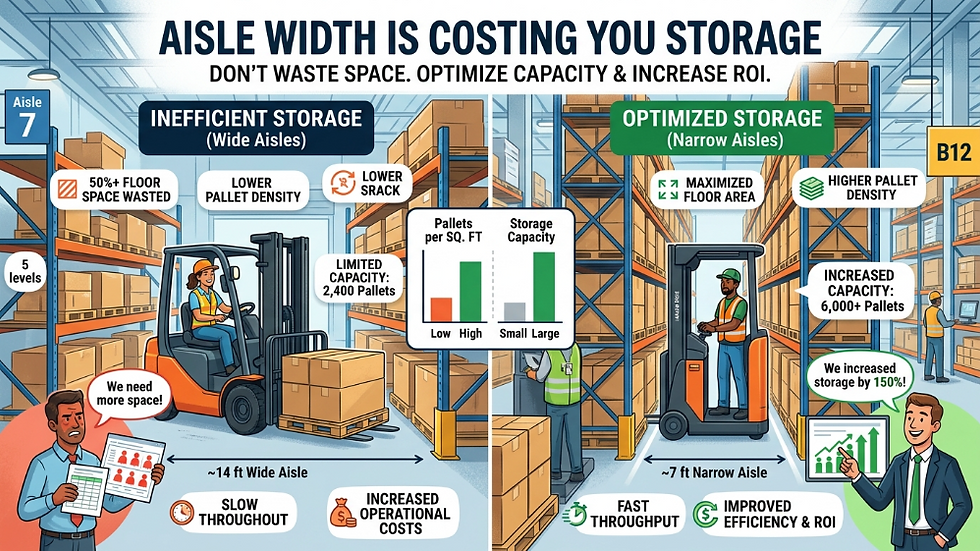
Standard aisle configurations are almost always wider than they need to be. That extra space is not safety. It is storage you are not using.
Narrow-aisle and very-narrow-aisle racking, paired with equipment built for tighter clearances, recovers meaningful floor space and redirects it toward inventory. A fishbone layout, where diagonal cross-aisles cut through the main runs, also reduces average travel distance per pick and works well when SKU variety is high, and orders come in frequently throughout the day.
If you have never measured your actual aisle clearance requirements against what your equipment spec sheet says, that is a good place to start this week.
Bad Data Undoes Good Organization
You can reorganize a warehouse perfectly and watch it fall apart within three months if the inventory data behind it stays inaccurate. Real-time tracking keeps stock levels, pick activity, and restocking needs visible throughout the day.
What that looks like in practice:
Workers know where something is before they walk toward it
Restocking happens before shelves run out, not after
Misplaced items get caught early, not during a customer complaint
Pick accuracy improves without adding supervision
Warehouses that combine smarter layouts with updated tracking systems report measurable gains in throughput, and facilities across the country are modernizing faster than they were even five years ago. The ones that wait tend to find themselves playing catch-up with competitors who moved earlier.
What One Operator Found After Making the Switch
Marcus Delray runs a 6,000-square-foot distribution operation for specialty hardware outside Atlanta. After switching to a vertical storage system last year, he cleared nearly a third of his floor space and added SKUs at the same time.
"The first few weeks were rough," he said. "The team had to learn the system, and there were a few hiccups with put-away sequencing. But once it clicked, the difference was obvious. We stopped losing time looking for things."
The con he would flag for anyone considering it: do not underestimate the training period. The system works, but it only works if the team trusts it and uses it consistently. Rushing that part is where most operations stumble.
The Takeaway
Small warehouse optimization is not a single project. It is a sequence of decisions, starting with observation and building from there. Most of the gains are available without major capital investment, and the ones that do require spending tend to pay back faster than expected once the operation is running the way it should.
If you take nothing else from this:
Audit pick frequency and reorganize placement before spending anything
Go vertical wherever ceiling height allows
Narrow your aisles if your equipment supports it
Invest in inventory tracking that updates in real time
Train your team on any new system before measuring results
The space you have is almost certainly enough. It just needs to work differently.