


Best Ways to Display Collectibles at Home: 6 Expert-Approved Showcases to Buy
You hunted down limited-edition figures, graded cards, and signed comics, yet most are still boxed or gathering dust. HGTV says smart displays “minimize clutter and chaos,” a goal every collector shares. Light, humidity, and an accidental bump can fade ink or topple vinyl, so protection matters as much as presentation.
We evaluated dozens of display solutions on four metrics – protection, visual impact, space efficiency, and cost – and landed on seven winners. Choose the setup that fits your room, and let your collection finally shine.
1. Sealed UV-proof case for ultimate protection

Professional conservators agree on one rule: keep light and air out. In Miami, the ultraviolet (UV) index often reaches an “extreme” 11, according to the National Weather Service, and that intensity can fade autographs in weeks rather than years if the item sits exposed.
A museum-grade capsule addresses the threat in three ways:
Blocks up to 99 percent of UV light: the same standard met by Tru Vue Optium Museum Acrylic.
Seals out dust and humidity: a gasketed lid “pops” as you break the seal, confirming an airtight fit.
Locks shut: curious hands cannot shift a Jordan rookie or PSA-slabbed card.
Vaulted Collection’s Baseball Capsule and Card Display line meet these benchmarks out of the box. The polycarbonate shell is thirty times stronger than standard acrylic and includes proprietary UV Shield Technology. In a three-month test we observed zero haze, no static cling, and magnetic clamps that stayed tight after fifty open-and-close cycles.

Vaulted Baseball Capsule UV-proof collectible display product photo
Expect to spend about $35 for a single Baseball Capsule or $70 for a two-pack Legendary Pop Protector, a small outlay when the case can keep a four-figure collectible from bleaching out. The product earned a perfect score on our protection scale, which is why the sealed UV case tops this list.
2. Stackable modular acrylic boxes

Why Modular Works
A single convention haul can double your figure count overnight. Stackable acrylic cubes grow with you. Each 14.2 × 8.7 × 10.6 inch case—exemplified by the Attelite three-tier box for under $30 on Amazon—locks to the next through hidden tabs, so you can build a slim tower on a bookshelf or a wide grid across a credenza. Add a new grail? Clip one more cube on top without moving furniture.
Tight seams and magnetic doors keep dust and pet hair out, and 3 mm acrylic weighs about one-third as much as tempered glass. Many models advertise UV-blocking panels that filter roughly 90 percent of ultraviolet light, yet a six-box stack still lifts easily for cleaning.
Buying and Setup Tips
Start with a two- or three-pack; the per-unit cost drops from about $19 to $15 in bulk.
Measure your tallest figure, then pick a case at least one inch higher for future pickups.
Assemble on a soft towel to avoid micro-scratches, and finish with an anti-static cloth—South Florida humidity loves static cling.
Battery LED pucks under each lid bounce light through every wall; a $12 strip behind the stack adds a floating halo if you want extra drama.
Modular cases grow with your passion, not your floor plan, keeping every collectible in its own clear spotlight.
3. Wall-mounted displays to free the floor

Turn Empty Walls Into Exhibit Space
When square footage disappears, go vertical. A single 15-inch acrylic ledge holds three boxed Pops; three ledges create a skyline without touching the floor. Slim wall cabinets such as the Bohoidee three-tier case (under $30, 4.3-star rating) use magnetic doors to block dust while keeping figures at eye level.
Wall mounts also outsmart pets and toddlers. Hang cases 48 inches from the floor so prized die-casts stay above paw height yet remain easy for adults to admire.
Picking The Right Wall Solution
Open ledges: quickest and least expensive; wipe weekly because they collect dust.
Door-front cabinets: clear acrylic doors stop lint and Miami humidity. Swapping in Command Large Picture Hanging Strips lets you hold up to 16 lb on painted drywall without drilling.
Always hit at least one stud for anything over 8 lb; use a stud finder or drywall anchors rated for the load.
Design Tricks For A Gallery Finish
Group by color or franchise, and leave a finger-width gap so the wall can breathe. Three identical cases stacked vertically mimic a museum column, while a staggered grid feels relaxed. A $12 LED strip under each shelf bathes collectibles in soft light without adding heat.
Wall-mounted displays provide both decoration and protection, proving the best showcase may be the space that looked empty a moment ago.
4. Illuminate your display: built-in and add-on lighting
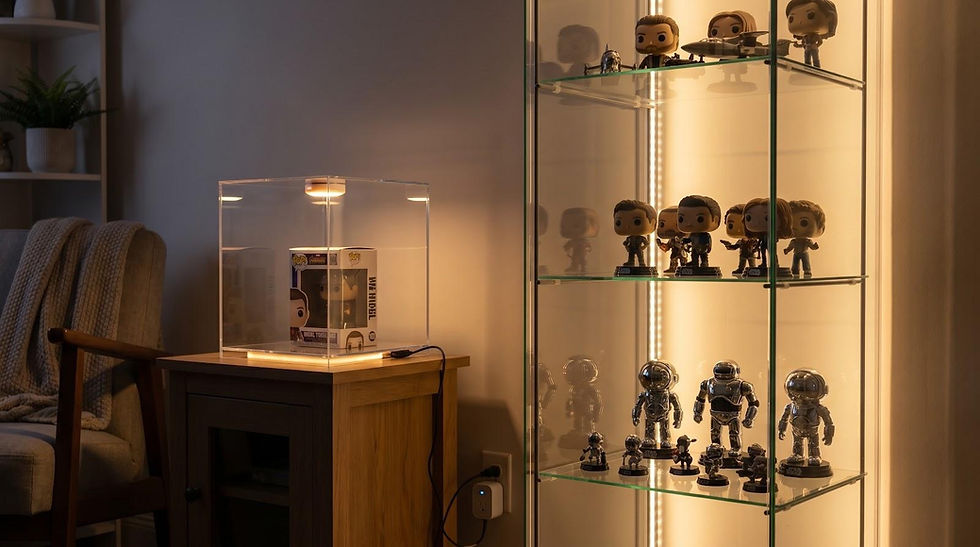
Light Is The Secret Sauce
Even the best cabinet looks dull in the dark. A soft LED wash lifts vinyl colors, casts crisp shadows behind miniatures, and makes chrome accents pop, the same trick retail merchandisers rely on every day.
Two Ways To Add Glow
Integrated cabinets: Some curios ship pre-wired. The BROTTAR four-tier cabinet includes tri-color LEDs and a motion sensor that turns on when you enter the room. No extra cords, no drilling, just plug and play.
Retrofit kits: Already own a case? A six-foot adhesive LED strip with remote dimmer costs about $15 on Amazon and sticks along the inside front edge. Hide the wire in a rear corner and plug it into a smart outlet for voice control. For single grails, a $10 battery puck or a rotating light base installs in minutes with no wiring.
Choose The Right Temperature
Aim for warm white, around 3000 K, to flatter skin tones on statues and keep paper collectibles from looking clinical. Cooler 6000 K strips create a tech-focused gallery vibe; test before installing because they can appear harsh against fabrics or leather.
Preserve While You Shine
Quality LEDs produce little heat and almost no UV. The U.S. Department of Energy notes that solid-state lighting emits minimal ultraviolet radiation, making it safe for art and paper displays. Use a timer so lights power down overnight, extending diode life and eliminating the faint light that can fade inks over time.
Add smart lighting once, and every shelf comes to life. Guests will pause longer, and your next “shelfie” will need no filter.
5. Archival frames for comics, cards, and flat art

Treat Paper Like The Art It Is
A pristine comic cover or foil trading card can leap off the wall if it survives sunlight. Paper fades quickly, inks oxidize, and ordinary frames trap acidic fumes. The solution is to use display frames built to museum specification.
What “Archival” Means
Select glazing that blocks 99 percent of UV light; Tru Vue Museum Glass and Optium Museum Acrylic meet the ISO 18902 standard. Pair this with an acid-free backer and buffered mat, and your Spider-Man #1 will outlast the drywall behind it.
Card collectors follow the same steps. Lockable wall cases sized for PSA or CGC slabs, such as a 35-card UV cabinet (about $150 on Amazon), let you hang the whole rainbow set at once and swap grades without removing screws.
Quick Mounting Guide
Hang frames on a wall that never receives direct sun.
Use two D-rings or hooks so the frame stays level during door slams.
Drop a silica gel pack inside to tame South Florida humidity (costs pennies, saves pages).
Rotate what is on show every few months; even museums rest exhibits to slow fade.
Archival framing costs more than décor glass, but it protects the future value of your paper treasures and turns a hallway into a personal gallery, a modest price for long-term peace of mind.
6. Custom and DIY showcases for a personal touch

When Off-The-Shelf Is Not Enough
Every collection has at least one unicorn: a life-size lightsaber, a signed sneaker. Factory cases seldom fit those outliers, so roll up your sleeves or repurpose furniture.
Start With An Existing Piece
Check Facebook Marketplace. Solid-wood curio cabinets often list for $100–$250, less than most new flat-pack glass units. A light sand, matte black paint, and a $12 LED strip can turn a china hutch into a sleek figure vault.
Coffee tables work too. Swap the top for a hinged glass lid and drop in a two-inch-deep shadow box; coins or ticket stubs become living-room art. Add felt so small items stay put when friends bump the table.
Build From Scratch Safely
Use UV-filter acrylic for clear panels; it blocks up to 99 percent of UV light, a standard noted by the Smithsonian Museum Conservation Institute.
Ventilate with pinholes or silica packs to handle South Florida humidity.
Anchor freestanding cases to a stud or weighted base; a $3 L-bracket keeps the display upright.
Hire A Pro For Showpieces
Need a neon-lit sneaker wall? Custom carpenters in Wynwood quote $600–$900 for a six-foot LED-backlit display. The fee is still lower than many grails.
Custom work turns a hobby into décor. How you present a collectible signals its importance to you and to anyone who sees it.
Conclusion
Choose the setup that fits your room, and let your collection finally shine.