


Barry University Leads Hands-On Training to Address South Florida’s Growing Healthcare Needs
Updated: Mar 19
As South Florida faces increasing emergency response demands alongside a nationwide healthcare workforce shortage, Barry University is emerging as a leader in hands-on healthcare training, preparing the next generation of professionals to respond when it matters most.

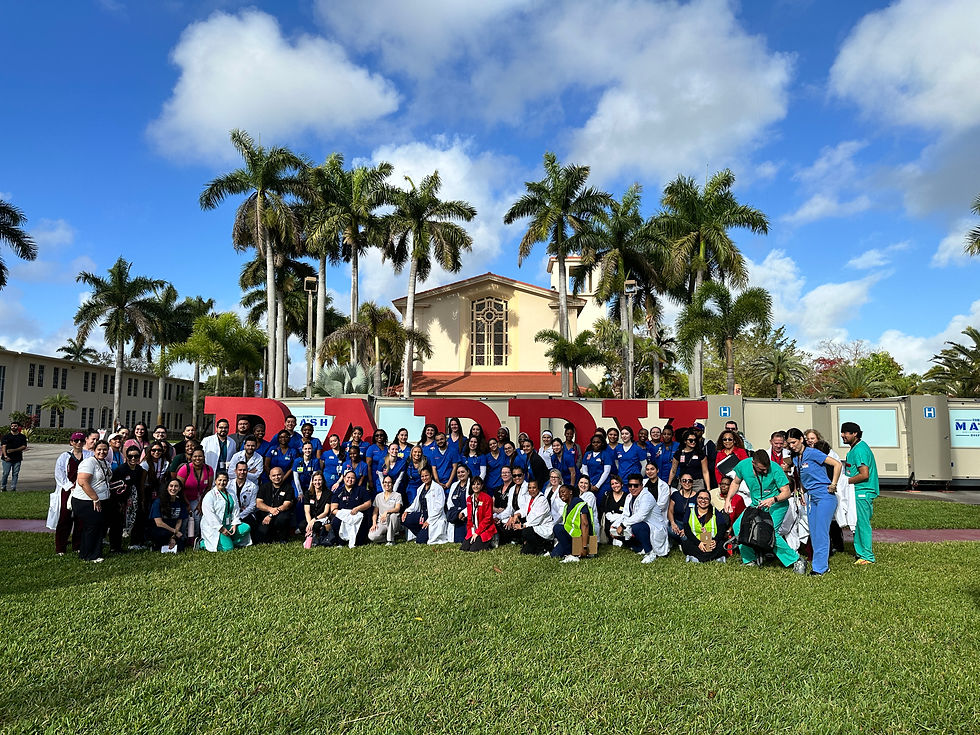
The university recently conducted its first full-scale Mass Casualty Incident simulation, SIMEX 2026, a large-scale training exercise designed to mirror real-world crisis conditions. Nearly 500 participants took part, including students across multiple healthcare disciplines, community partners, and Miami-Dade high school students who observed the exercise.
Two months in the making, the simulation centered on a staged bus crash involving 19 trauma patients. Students were tasked with performing triage, administering treatment, and coordinating care within a fully operational mobile hospital environment, replicating the urgency and complexity of an actual emergency response.
Miami-Dade Fire Rescue participated in the exercise, adding to the realism and pace of the response. FORTS Logistics, a key partner in the simulation, supported the deployment and operation of mobile medical units, helping recreate the infrastructure required during large-scale emergencies. Notably, the company’s CEO, Ruben Almaguer, is a Barry University alumnus who returned to campus to help bring the simulation to life.
While first responders across the region were managing real crises, students at Barry were simultaneously training to step into those roles. The exercise emphasized not only clinical skills, but also communication, collaboration, and patient-centered care under pressure which are critical components of today’s healthcare environment.

“Barry University is taking the lead in educating the next generation of healthcare providers who are ready for the growing complexity of today’s healthcare environment,” said Dr. Eneida Roldan, executive dean of Barry University’s College of Health Professions and Medical Sciences. “These students are well prepared in the classroom and through independent simulations, but now they are ready from day one to work in an interdisciplinary healthcare ecosystem.”
For students, the simulation offered a rare opportunity to experience the human side of emergency response. “If I could save a life or help a family, that’s what I’m going to do this for,” said Matt Bellando, a future paramedic studying at Barry University.
During the exercise, Bellando took on the role of a patient in the simulated crash scenario. “My character today was Ethan. I was ejected from the vehicle and had bilateral tibia-fibula fractures, both legs were broken,” he said.

The experience reinforced one of the most important lessons of the training:
compassion under pressure. “Even when the response is quick, it still takes time,” Bellando added. He added that the exercise helped him better understand what patients go through and reinforced that compassion is just as important as treatment.
The simulation reflects a broader shift in healthcare education toward interdisciplinary, real-world training models that mirror the coordination required during actual emergencies. As the demand for skilled healthcare professionals continues to grow, initiatives like SIMEX 2026 position Barry University at the forefront of preparing students to meet the needs of both the community and the evolving healthcare system.