


Artemis II Moon Flyby Best Photos: Stunning Views of Earth and the Moon
Miami Living brings you our favorite images from Artemis II, capturing the mission from launch to its return to Earth. These newly released photos go beyond visual beauty, reflecting a rare intersection of exploration, technology, and awe. Special thanks to NASA for these incredible images!
Artemis II Launch
NASA’s SLS (Space Launch System) rocket lifted off from Launch Pad 39B at the agency’s Kennedy Space Center in Florida at 6:35 p.m. EDT on April 1, 2026, sending NASA astronauts Reid Wiseman, Victor Glover, and Christina Koch and CSA (Canadian Space Agency) astronaut Jeremy Hansen aboard the Orion spacecraft on a planned test flight around the Moon and back.

Artemis II crew and backup astronauts pose with NASA’s SLS rocket and Orion spacecraft during rollout to Launch Pad 39B at Kennedy Space Center ahead of their planned Moon mission and return to Earth. Credit: NASA/Joel Kowsky

Artemis II astronauts Victor Glover, Reid Wiseman, Jeremy Hansen, and Christina Koch depart crew quarters at Kennedy Space Center en route to Launch Pad 39B during a launch day timeline test. Credit: NASA
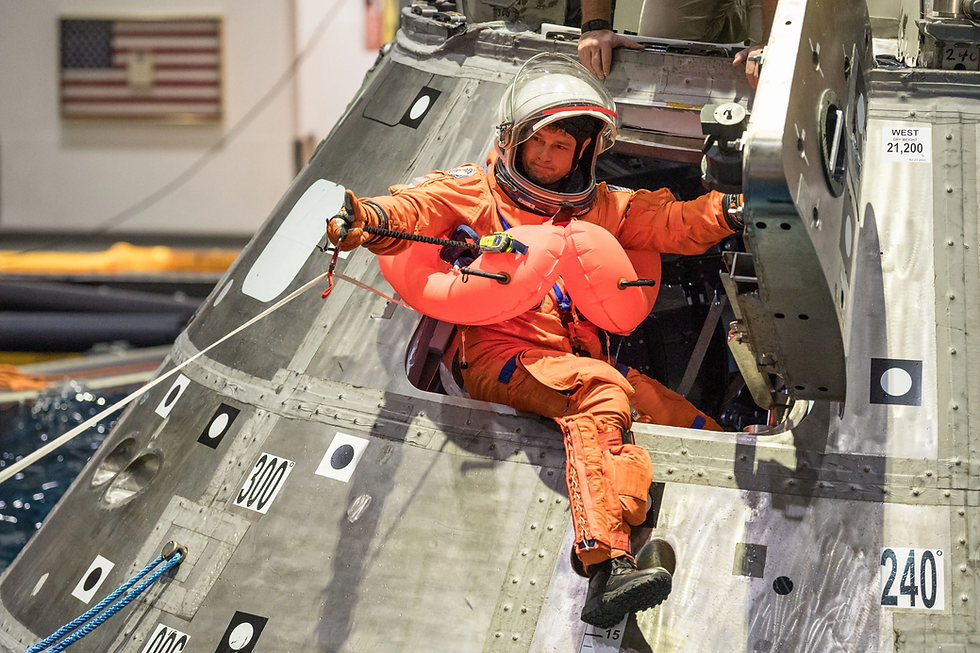
Artemis II commander Reid Wiseman trains in a mock Orion spacecraft at NASA’s Neutral Buoyancy Lab, practicing splashdown recovery procedures ahead of the Moon mission.

NASA’s SLS rocket launches the Artemis II crew—Reid Wiseman, Victor Glover, Christina Koch, and Jeremy Hansen—from Kennedy Space Center at 6:35 p.m. on a 10-day mission around the Moon and back aboard the Orion spacecraft. Credit: NASA/Joel Kowsky

NASA’s Space Launch System rocket launches carrying the Orion spacecraft with NASA astronauts Reid Wiseman, commander; Victor Glover, pilot; Christina Koch, mission specialist; and CSA (Canadian Space Agency) astronaut Jeremy Hansen, mission specialist on NASA’s Artemis II mission, Wednesday, April 1, 2026, from Operations and Support Building II at NASA’s Kennedy Space Center in Florida. NASA’s Artemis II mission will take Wiseman, Glover, Koch, and Hansen on a 10-day journey around the Moon and back aboard SLS rocket and Orion spacecraft launched at 6:35pm EDT from Launch Complex 39B. Image Credit: NASA/Bill Ingalls

In a three-minute exposure, NASA’s SLS rocket launches the Artemis II crew—Reid Wiseman, Victor Glover, Christina Koch, and Jeremy Hansen—from Kennedy Space Center at 6:35 p.m. EDT on a 10-day journey around the Moon and back aboard the Orion spacecraft. Photo: NASA/Keegan Barber.

Guests at Banana Creek watch NASA’s SLS rocket launch the Artemis II crew—Reid Wiseman, Victor Glover, Christina Koch, and Jeremy Hansen—from Kennedy Space Center at 6:35 p.m. EDT on a 10-day mission around the Moon and back. Photo: NASA/Keegan Barber.

Artemis II lead capcom Stan Love (right) and Artemis II chief training officer Jacki Mahaffey (middle) have a conversation in Mission Control's White Flight Control Room at NASA's Johnson Space Center during launch and ascent on Wednesday, April 1, 2026. Credit: NASA/Robert Markowitz Image Credit: NASA/Robert Markowitz

Members of the Artemis lunar science team gather in Mission Control’s Science Evaluation Room at Johnson Space Center, posing with the Artemis II launch broadcast as they support real-time lunar science and mission operations. Photo: NASA/Mark Sowa.
Artemis II Journey to the Moon

Before going to sleep on flight day 5, the Artemis II crew snapped one more photo of the Moon, as it drew close in the window of the Orion spacecraft. Orion and the four humans aboard entered the lunar sphere of influence at 12:37 a.m. EDT on April 6, at the tail end of the fifth day of their mission. That marked the point at which the Moon's gravity had a stronger pull on the spacecraft than the Earth's. Artemis II's closet approach to the Moon will come on flight day 6, as they swing around the far side before beginning their journey back to Earth. About an hour after entering the lunar sphere of influence, Artemis II Mission Specialist Christina Koch said, "We are now falling to the Moon rather than rising away from Earth. It is an amazing milestone!" Image Credit: NASA

A view of Earth taken by NASA astronaut and Artemis II commander Reid Wiseman from one of the Orion spacecraft's four main windows after completing the translunar injection burn on April 2, 2026.

NASA astronaut and Artemis II mission specialist Christina Koch, seen here on the fourth day of the mission, prepping for lunar flyby activities after completing aerobic exercise on the flywheel device. Credit: NASA Image Credit: NASA

Artemis II mission specialist and CSA (Canadian Space Agency) astronaut Jeremy Hansen enjoys a shave inside the Orion spacecraft during Flight Day 5 and ahead of the crew's lunar flyby on April 6, 2026. Image Credit: NASA

NASA astronaut and Artemis II Commander Reid Wiseman peers out of one of the Orion spacecraft's main cabin windows, looking back at Earth, as the crew travels towards the Moon. Image Credit: NASA

A view of a backlit Earth taken by NASA astronaut and Artemis II Commander Reid Wiseman from one of the Orion spacecraft's window after completing the translunar injection burn on April 2, 2026. Image Credit: NASA
Artemis II Lunar Flyby Images
The first flyby images of the Moon captured by NASA’s Artemis II astronauts during their historic test flight reveal regions of the Moon's far side, as well as an in-space solar eclipse. Released April 7, 2026, NASA astronauts Reid Wiseman, Victor Glover, and Christina Koch and CSA (Canadian Space Agency) astronaut Jeremy Hansen captured the images during the mission’s seven-hour flyby on April 6, 2026, showing humanity’s return to the Moon’s vicinity.

Mission Specialist Christina Koch (top left), Mission Specialist Jeremy Hansen (bottom left), Commander Reid Wiseman (bottom right), and Pilot Victor Glover (top right) – uses eclipse viewers, identical to what NASA produced for the 2023 annular eclipse and 2024 total solar eclipse, to protect their eyes at key moments during the solar eclipse they experienced during their lunar flyby. This was the first use of eclipse glasses at the Moon to safely view a solar eclipse. Image Credit: NASA

Echoing the iconic Earthrise photo captured by the Apollo 8 astronauts in 1968, during the lunar flyby, the Artemis II crew captured a shot of Earthset as they passed behind the Moon’s far side. It is one of many photos taken during the seven-hour lunar flyby by the Artemis II crew on the Orion spacecraft. Credit: NASA


Our planet draws closer to passing behind the Moon in this image captured by the Artemis II crew during their lunar flyby, about six minutes before Earthset. Earth is in a crescent phase, with sunlight coming from the right. The dark portion of Earth is experiencing nighttime. On Earth’s day side, swirling clouds are visible over muted blue in the Australia and Oceania region. The lines of small indentations on the Moon’s rugged surface are secondary crater chains. These structures are formed by material ejected during a violent primary impact. Image Credit: NASA

The Artemis II crew captures a faint view of a crescent Earth above the horizon on the Moon’s far side. Image Credit: NASA


Captured by NASA’s Orion spacecraft during the Artemis II mission on April 6, 2026, this striking image shows the Moon backlit by the Sun during a solar eclipse. Orion appears in the foreground on the left, while Earth’s reflected sunlight softly illuminates the Moon’s left edge. Just below the Moon’s lower right edge, Saturn is visible as a bright point, with Mars appearing as another bright point near the far right edge of the frame. Photo/NASA
Artemis II Return to Earth
NASA astronauts Reid Wiseman, Victor Glover, and Christina Koch and CSA (Canadian Space Agency) astronaut Jeremy Hansen splashed down at 8:07 p.m. EDT on April 10, 2026, off the coast of San Diego, completing a nearly 10-day journey.


Long Distance Call: Members of the International Space Station Expedition 74 (left) and Artemis II (right) crews are seen at once on the screens inside the International Space Station flight control room in Mission Control at NASA's Johnson Space Center in Houston. The two crews connected in a 15-minute ship-to-ship call on April 7, 2026, while the Artemis II crew was on its way back from the Moon.

The Artemis II crew – (from left) Mission Specialist Christina Koch, Mission Specialist Jeremy Hansen, Pilot Victor Glover, and Commander Reid Wiseman – pause for a group photo inside the Orion spacecraft on their way home. Following a swing around the far side of the Moon on April 6, 2026, the crew exited the lunar sphere of influence (the point at which the Moon's gravity has a stronger pull on Orion than the Earth's) on April 7, and are headed back to Earth for a splashdown in the Pacific Ocean on April 10.

NASA’s Orion spacecraft is pictured here from one of the cameras mounted on its solar array wings. At the time this photo was taken at 8:33 a.m. ET, the Artemis II crew was in a sleep period ahead of beginning their seventh day into the mission.

Following a swing around the far side of the Moon on April 6, 2026, the crew exited the lunar sphere of influence (the point at which the Moon's gravity has a stronger pull on Orion than the Earth's) on April 7, and are headed back to Earth for a splashdown in the Pacific Ocean on April 10. The crew was selected in April 2023, and have been training together for their mission for the past three years.
WITNESS A LAUNCH

Photo/NASA: Mission Type: Crewed Lunar Flyby. Crew Size: 4. Launched: April 1, 2026. Mission Duration: 10 Days
And for those inspired to witness history firsthand, there’s nothing quite like experiencing a launch in person. From the best viewing spots to tips on planning your visit, Miami Living presents a special guide with everything you need to make it happen.